Seeder And Demo Data Guide
The project ships with multiple seeder entry points so buyers can choose between a safe baseline, essential app data, CRM defaults, full demo data, or a flagship showcase environment.
Production rule: do not run demo seeders on a live customer database. Use
demo seeders only for staging, QA, sales demos, or local development.
1) Seeder Hierarchy
- InstallerRequiredSeeder: installer-safe baseline that calls the full
RoleAndPermissionSeeder, creating the complete permission catalog before the first Admin user is assigned. - EssentialDataSeeder: required permissions, default CRM pipeline, and enterprise catalog.
- DatabaseSeeder: users, settings, full permissions, CRM defaults, and enterprise catalog.
- InstallerDemoSeeder: deterministic demo dataset through the CRM demo service.
- FlagshipStarterSeeder: base app + enterprise catalog + demo dataset + showcase users.
2) Recommended Commands
# Base application data
php artisan db:seed

# Minimal essential app data
php artisan db:seed --class=EssentialDataSeeder

# CRM demo dataset only
php artisan db:seed --class=InstallerDemoSeeder

# Full flagship showcase environment
php artisan db:seed --class=FlagshipStarterSeeder
3) Seeded Users
Default Credentials
- Admin:
admin@ovion.tech/Demo@12345 - Manager:
demo-manager@ovion.tech/password - Agent:
demo-agent@ovion.tech/password - Client portal:
apex-client@revenuepilot.test/password
4) What Gets Seeded
- General and branding settings with Ovion defaults.
- Admin, Manager, and Employee roles with CRM and platform permissions.
- Default sales pipeline, stages, playbooks, lead forms, lead sources, follow-up discipline, and core CRM baseline.
- Demo proof records for the public landing page: companies, contacts, leads, deals, quotations, invoices, projects, tasks, tickets, files, delivery notes, and portal users.
- Enterprise catalog records: feature flags, plugin/sample-pack records, provider connections, API clients, webhooks, backup proof, and marketplace proof controls.
- Sandbox-only records for payment gateways, accounting providers, support mailbox import, ad campaigns, AI Bot sync, and provider webhooks.
5) Idempotency
Core seeders are designed to be re-runnable. Settings use upsert behavior, CRM defaults use first-or-create behavior, and seeded users now upsert by email instead of blindly inserting duplicates.
6) Demo Walkthrough Path
- Sign in as admin and open
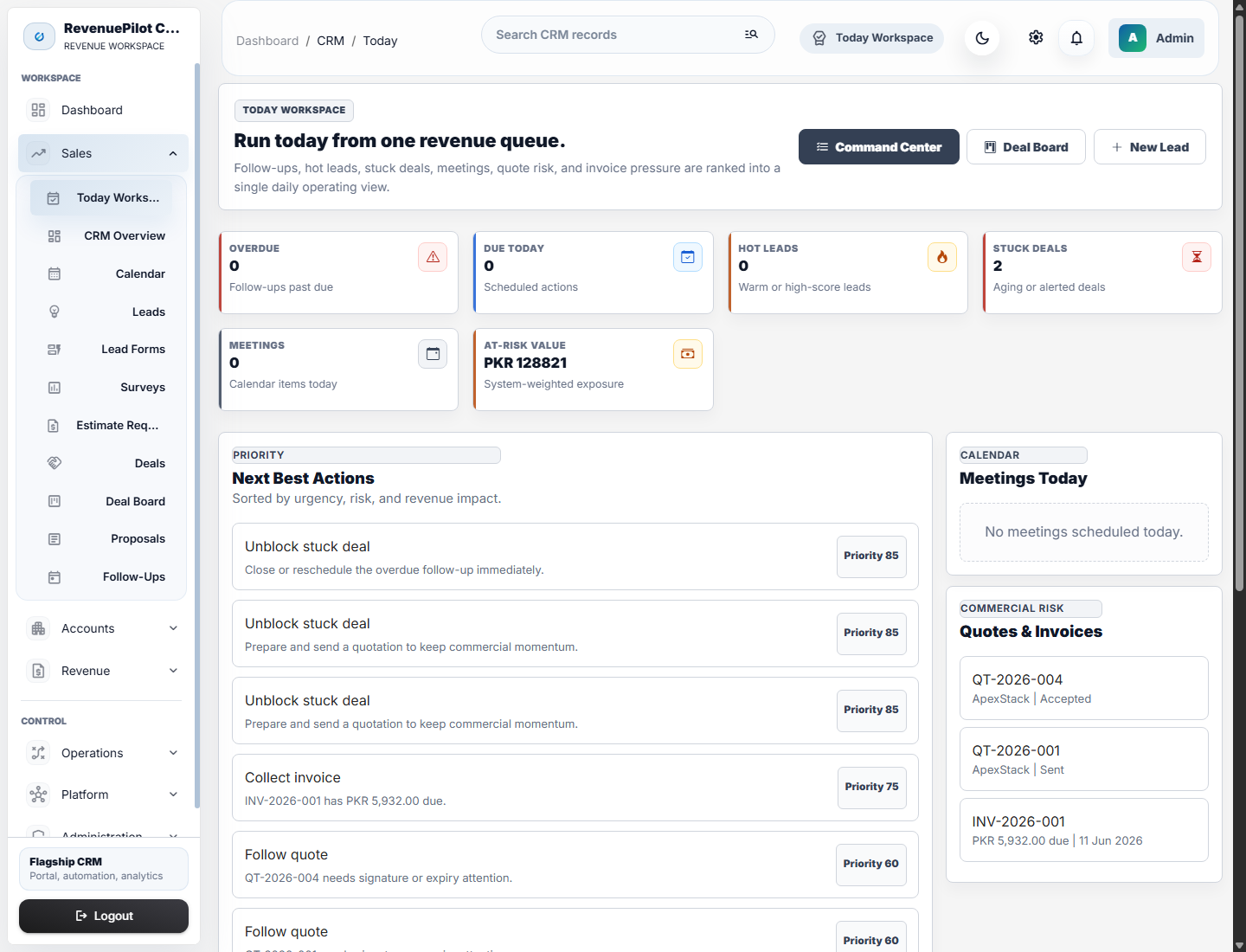
/crm/dashboard, then review/crm/today. - Open leads, campaigns, and lead forms; convert a lead into a deal.
- Move the deal on
/crm/deals/board, add follow-ups, stakeholders, notes, and an AI draft. - Create or review a quotation, refresh the public quote link, and generate a deposit invoice.
- Open invoices, payment session simulation, refunds, delivery notes, reports, and scheduled report setup.
- Review projects, task board, support inbox, ticket replies, and customer success workspace.
- Sign in as the portal client and verify deals, quotations, invoices, projects, tasks, files, tickets, requests, approvals, calendar, and security.
- Run System Health and marketplace proof pages before taking screenshots.
7) Readiness Commands
php artisan crm:portal-readiness-check
php artisan crm:sync-support-mailboxes
php artisan crm:sync-accounting-providers
php artisan crm:sync-payment-gateways
php artisan crm:retry-payment-events
php artisan crm:run-recurring-billing
php artisan revenuepilot:marketplace capture-screenshots
8) Demo controls in production
demo_mode_enableddefaults tofalse. Enable it only for sales demos or buyer previews that intentionally expose/demo-preview.- Public demo/test surfaces are disabled or gated by authentication, installation state, permissions, throttles, and demo/debug mode.
- Demo seeders configure sandbox and simulation records only. Do not run demo seeders on a live customer database.
- After seeding a demo, run the readiness center and portal readiness command before capturing marketplace screenshots.
Demo Studio Reference